


How We Value Uranium Miners: A Don Durrett-Inspired Method
If you have not already added Don’s book, How to Invest In Gold and Silver – D. Durrett, to your library, what are you waiting for. We borrow the framework outlined in chapter 10, but with some important adjustments.
Before we dive in, visit this report we produced this week from NXE by clicking the image/button below. It will give you some hard examples of what we are going to explain below.

Executive Summary
What do we mean by Sum-Of-The-Parts? Simple. This is sum of all present value of assets independently minus the sum of all present value of liabilities. The present value of something is merely a time + probability discount to present day. Mine is a sure thing, starts in four years… NPV = 100% times (1/1.05)^4 times whatever that mine is worth at open.
This valuation model is simple liner probability. That is to say, we discount value for every contingency. If you don’t hold it, you don’t own it. In the case of uranium, you can hold it, but not for very long. Apparently, that is the correct view of the stocks as well.
Mining or drilling is a simple matter of unlocking resource into a usable, recognizable, standardized state of value (generally as a producer good into something else). Refined gasoline, pure silver bars…etc. The value of a uranium energy product U3O8 is the future sale price, discounted by milling, transportation, ISR or digging, leasing, finding, financing, marketing and various other capitalized expenditures. That’s a lot of middle-men to pay and the word we pay them with in present value terms is… discounting. Modeling so many parts demands knowledge beyond this author’s ability from project to project. Therefore, we adopt simplifying assumptions. There are things we don’t know that we can make a guess, and there are some things we just don’t know we don’t know. Be conservative in assumption setting. The simpler the assumptions the easier the result is to defend!
Simple Formula:
Where:
sᵢ = development-stage valuation factor for project i.
Lᵢ = attributable plausible pounds of U₃O₈.
Nᵢ = modeled mine life in years.
P = flat uranium-price scenario: $85, $100, or $150 per pound.
AISCᵢ = all-in sustaining cost per pound.
Dᵢ = years from the valuation date until the start of the first production year.
y = production year, from 1 through Nᵢ.
Dᵢ + y − 0.5 = mid-year cash-flow timing, expressed in years from the valuation date.
1.30 = cost multiplier incorporating the 30% cost pad.
1.05 = one plus the assumed 5% annual discount rate.
…lets walk through it.
Step 1: Determine Plausible Pounds
Don creates a simple framework for discounting Measured, Indicated and Inferred. The coefficients of each (probabilities) are the discretion of the user. This user has chosen very conservative figures in {.9,.65 and .3}. This is due to the fact that the uranium market isn’t so often categorized as Proven and Probable yet. Rule of thumb is not to pay for what you don’t know. And we don’t know what % of the lower tier of minerals will materialize above ground.
These assumptions can be easily adjusted on project by project basis with more informed information and likelihood.
Rule of thumb is not to pay for what you don’t know.
Example (NXE):
All figures are in millions of pounds of U₃O₈. At 100% ownership, NexGen’s attributable plausible pounds in this example equal approximately 251.0 million pounds.
Step 2: Flat Price Scenarios, Padded Costs
Financiers account for the cost of a single pound of uranium from the ground as All In Sustaining Cost. This number is hardly that. It doesn’t account for tax or certain overhead costs. We adjust the known AISC by a factor of 1.3 to reduce some margin to pay these other bills. One thing is 100%, the powers of jurisdiction will want theirs once money is made.
Step 3: Project Stage Factors
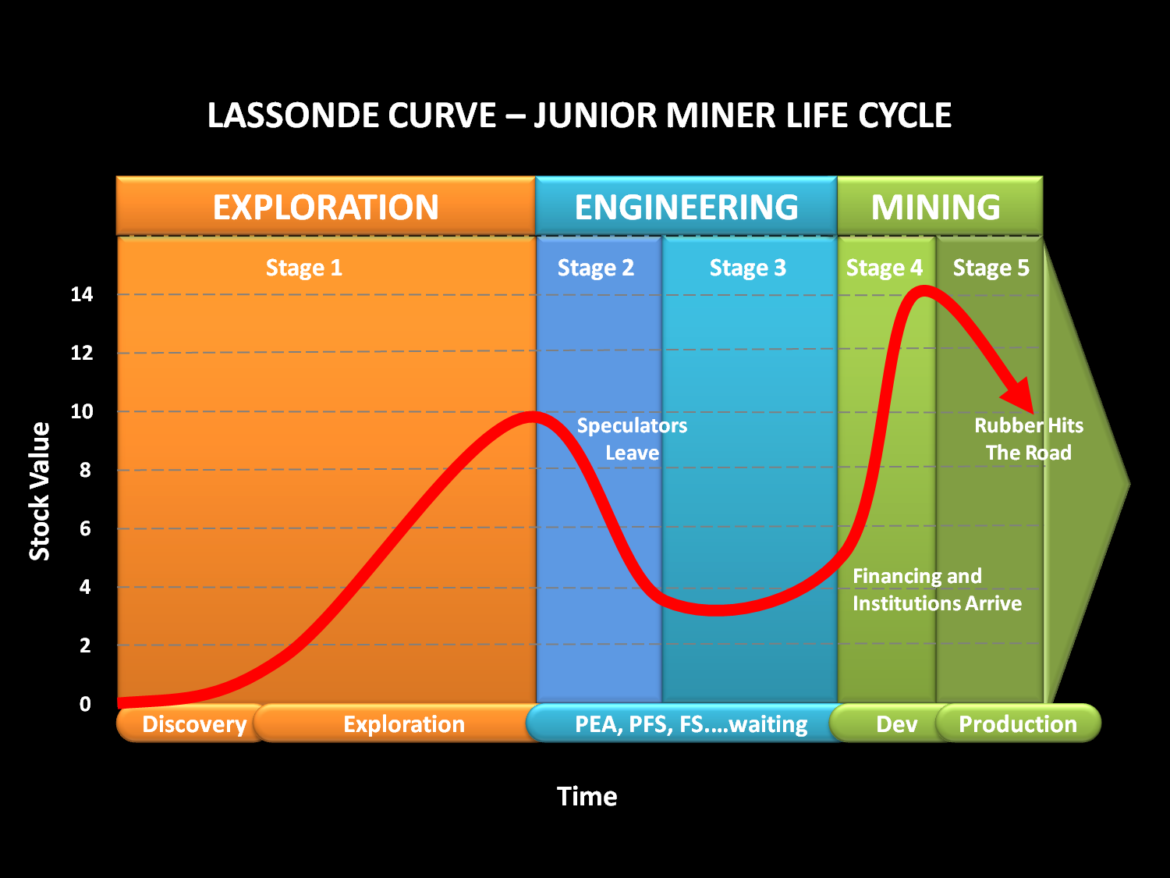
The lifecycle image of natural resources and mining looks like this when compared to time. This image has 5 stages, our model has more. As we move from left to right, we move from uncertainty towards more certainty and eventual maturity.
We use the following factors to represent the likelihood of success in each of the pre-production states. These are conservative. In the analysis of each individual company there is an estimate of future capex fund raising as a liability. In some since this is a degree of double counting. These factors can represent uncertainty of both financing and the project scale.
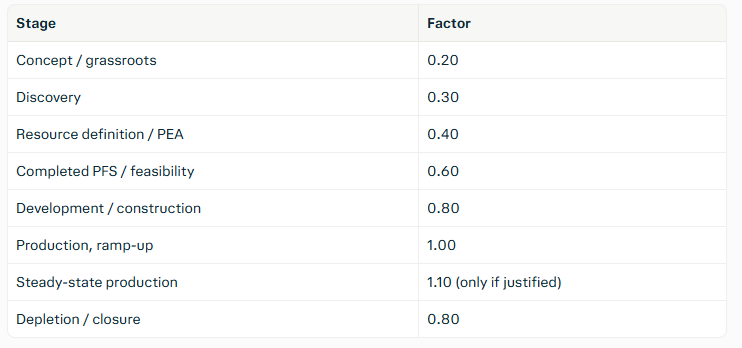
We are buyers, we don’t want to pay too much uncertainty if we don’t have to. 30% discounts to present NPV should be considered very attractive.
Step 4: Discount at 5%, mid-year
We use a discount factor of 5% to account for time. This is currently essentially the risk free rate. Other contingencies loaded in elsewhere, this is a standard approach for high quality jurisdictions.
Step 5: Bridge to equity value per share
Equity value = Σ project NAVs − remaining initial capex − debt and other obligations + cash + other investments and assets
Divide by fully diluted shares. Check cash, listed securities, uranium inventory, property, leases, product loans and reclamation obligations. Sustaining capex already inside AISC is not deducted twice. Convertibles are either converted (shares in, debt out) or treated as debt, never both.
Step 6: Check Life of Mine & Verify Resource Estimates
The definitive resource estimates are in the NI 43-101 technical report filed on SEDAR+. They are no or less accurate than any other estimate, but they are created AND SIGNED OFF by independent, professional geologists.
Alongside this data is the expected life of production from the mine. This is another estimate as is production rate. We aren’t picking up any expansion in this calculation so face value of the mine life should suffice for a conservative projection.
The Ten-Factor Scorecard From Don Durrett
Each factor is scored 1–10 and the total is the simple average:
Properties and ownership
People and management
Share structure
Location
Projected growth
Good buzz and chart
Cost and financing
Cash and debt
Low valuation estimate
Upside potential
Any factor below 6 is flagged as a concern. We also separate asset quality from jurisdiction. A Tier 1 country doesn’t make a Tier 3 deposit a good mine, and the reverse is also true.
The purpose of this examination isn’t to rate how good we are and by the highest score card. The purpose is to interrogate the weakest links of companies and projects with otherwise attractive investment pricing. Any investment relations publication will be happy to tell you what can go right on the front page of their website. Finding what can go wrong is the assignment of every investor, and that requires digging and interrogating the thesis. That is the purpose of this step.
What the Model Leaves Out
Optionality valued at zero. Unsupported exploration upside is excluded from the base case. That doesn’t make it worthless, but it can understate value.
Conservative and aggressive features. Resource haircuts, stage haircuts and the cost pad are conservative. A flat $150 price, a 5% discount rate and a simplified production profile can inflate value. We don’t call the whole model conservative.
Bottom Line
The method is a disciplined way to ask what the assets could be worth under stated assumptions. It does not predict where the shares will trade. All values are hypothetical, resources are not reserves, and mining equities can lose all principal.
Complete Report on NXE 0.00%↑
https://fifthgenerationadvisers.com/research/FGA_NXE_10092026.pdf
If you enjoy content like this, consider becoming a paid subscriber at the current rate. I will be releasing many more of these in the Uranium space and other sectors to paid subscribers!
https://fifthgenerationadvisers.com is independent investment advisory service committed to honest due diligence and has not been compensated in any form to produce this analysis. All opinions are our own, this is not investment advice.
The information provided is for educational and informational purposes only and should not be construed as investment advice. All investments carry risk, and past performance is not a guarantee of future results. Trading options involves a high degree of risk and is not suitable for all investors.